Truckload Liquidation Cost Breakdown: Price, Freight, Labor, Resale
Truckload Liquidation Cost Breakdown: Price, Freight, Labor, Resale
Most first-time buyers take the truckload price, divide it by the unit count, and call that their cost. It looks great on a spreadsheet and it's wrong almost every time. The real liquidation truckload cost is what you've spent after freight, labor, supplies, and the units that never make it onto a shelf or a listing.
This post walks through one worked example, and every number in it is an example, not a quote. Swap in your own figures as you go. By the end you'll have a landed cost per sellable unit and a break-even sell-through rate you can test against any manifest before you commit money.
What goes into liquidation truckload cost
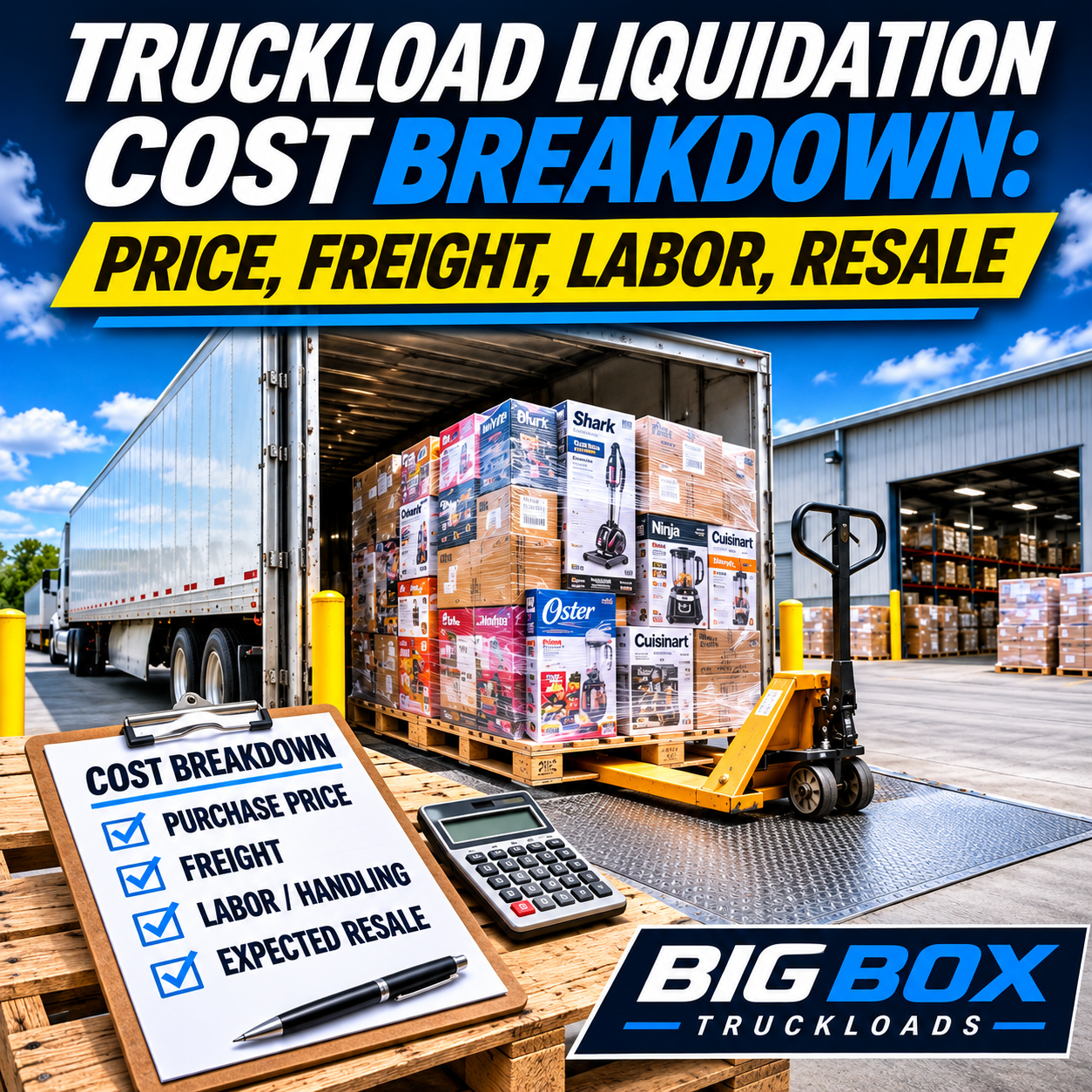
Think of four buckets. First is the load price, which is what you pay the seller. Second is delivery, meaning the freight from the retailer's or liquidator's dock to yours. Third is labor and supplies: unloading, sorting, testing, cleaning, photographing, and listing. Fourth is shrink, the units that are damaged, missing, or simply not sellable at a decent price.
The first bucket is the only one that shows up on the invoice, which is why people underbudget the rest. Before you price anything, read How it works so you know what a manifest tells you, how loads are described, and what is and isn't guaranteed. That context changes how much shrink you should plan for.
Step one: load price and freight
Here's our example load. It's a mixed general merchandise truckload with 1,000 units on the manifest and a total manifest retail value of $30,000. The load price is $6,000, which is 20% of retail. That's an example ratio only. Real ratios depend on category, condition, and how the load is sourced.
Freight on a full truckload to a commercial dock, in this example, is $1,100. Your number will move with distance, fuel, and season. If you don't have a loading dock, expect extra charges for a liftgate or a smaller truck, so ask about that before you buy, not after the driver shows up.
Running total so far: $6,000 + $1,100 = $7,100.
Step two: labor and supplies
A full trailer doesn't turn itself into inventory. Someone has to unload pallets, break them down, check items against the manifest, test anything with a plug, and sort by sell path. In our example that's 40 labor hours at $18 an hour, or $720. If you're doing the work yourself, still count it. Your hours aren't free, and a load that only pays when your time is zero isn't a good load.
Add supplies and disposal. Pallet wrap, boxes, labels, shelving space, and a dumpster run for trash and unsellable junk come to $230 in this example.
Running total: $7,100 + $720 + $230 = $8,050. That's your all-in spend before shrink. Divided by 1,000 manifest units it's $8.05 each, but that isn't the real number yet.
Step three: shrink, the line item buyers underestimate
Shrink is every unit you paid for and can't sell at a normal price. That includes crushed boxes, broken items, missing pieces, units that fail testing, and anything short versus the manifest. Some of it you'll sell cheap or donate, but plan as if it's zero revenue.
Say 10% shrink in our example. That's 100 units, leaving 900 sellable units. Now divide: $8,050 ÷ 900 = about $8.94 per sellable unit. At 20% shrink you'd have 800 sellable units and a landed cost of about $10.06. Same truck, same invoice, and a 12% higher real cost per unit.
Shrink varies a lot by category. Sealed, boxed goods tend to behave better than fragile or heavily handled items. Use the manifest and the condition description to set your own assumption, and be conservative on your first load in any new category.
Stephen’s Rule: Never price a load off the manifest count. Divide your total landed spend by the units you realistically expect to sell, then build your margin from that number.
Break-even sell-through at a $20 average price
Landed cost tells you what you've put in. Break-even tells you how much has to sell before you stop losing money. Assume an average realized selling price of $20 per unit and 10% in marketplace, payment, or card fees, which is $2. Your net is $18 per unit sold.
Break-even units = $8,050 ÷ $18 = about 447 units. That's roughly 45% of the 1,000 units you received, or just under 50% of the 900 sellable ones. Sell through half of what's usable and the load has paid for itself. Everything after that is margin, minus the cost of keeping slow stock around.
Look at the upside from here. Sell 70% of the sellable units (630) and you net $11,340, which is $3,290 over the $8,050 you spent. Sell all 900 and you net $16,200, or $8,150 in profit. Those are example outcomes, but the shape holds up: once you pass break-even, each extra sale drops mostly to profit.
This is why liquidation truckload cost should always be paired with a sell-through target. A cheap load you can't move is more expensive than a pricier one that clears.
How the math shifts when prices or timing change
The most sensitive input is your average selling price. Drop our example from $20 to $14 and your net per unit falls to $12.60. Break-even is now 639 units, which is about 64% of what you received and 71% of what's sellable. A 30% price drop pushed the break-even target up by roughly 19 percentage points of total units. Price assumptions deserve more scrutiny than almost anything else in the model.
Timing matters too. Slow sellers tie up cash and shelf space, and some categories sell best in a specific season. If you're buying returns-heavy inventory around the holidays, it helps to understand when to buy January post-holiday liquidation truckloads and how that mix differs from a mid-year load.
A practical habit: run your model three ways. Use a base case, a pessimistic case with higher shrink and lower prices, and a best case. If the pessimistic version still breaks even at a sell-through rate you've actually hit before, the load is a reasonable bet.
Run your own numbers before you buy
Put the whole thing on one sheet. List load price, freight, labor hours times your rate, supplies, and your shrink assumption. Divide by sellable units for landed cost, then divide by your net price per unit for break-even. It takes ten minutes and it's the cheapest insurance you'll buy.
Then ask the questions the spreadsheet can't answer. Is the manifest itemized? How is condition described? What does delivery to your dock cost, in writing? If you want pricing on a specific load with freight included, get a quote and plug the real figures into your model before you decide.
More Related Posts